Pay-per-click advertising remains one of the fastest ways to generate leads and sales — when it’s managed correctly. Done poorly, PPC drains budgets with clicks that never convert. Done well, it becomes a predictable, scalable revenue channel that delivers measurable ROI from day one.
With over 20 years of combined experience managing paid campaigns across Google Ads, Microsoft Ads, and social platforms, the SkyhawkBiz team has seen firsthand what separates profitable PPC accounts from wasted ad spend. Here’s our complete 2026 guide to getting PPC right.
What Is PPC Advertising?
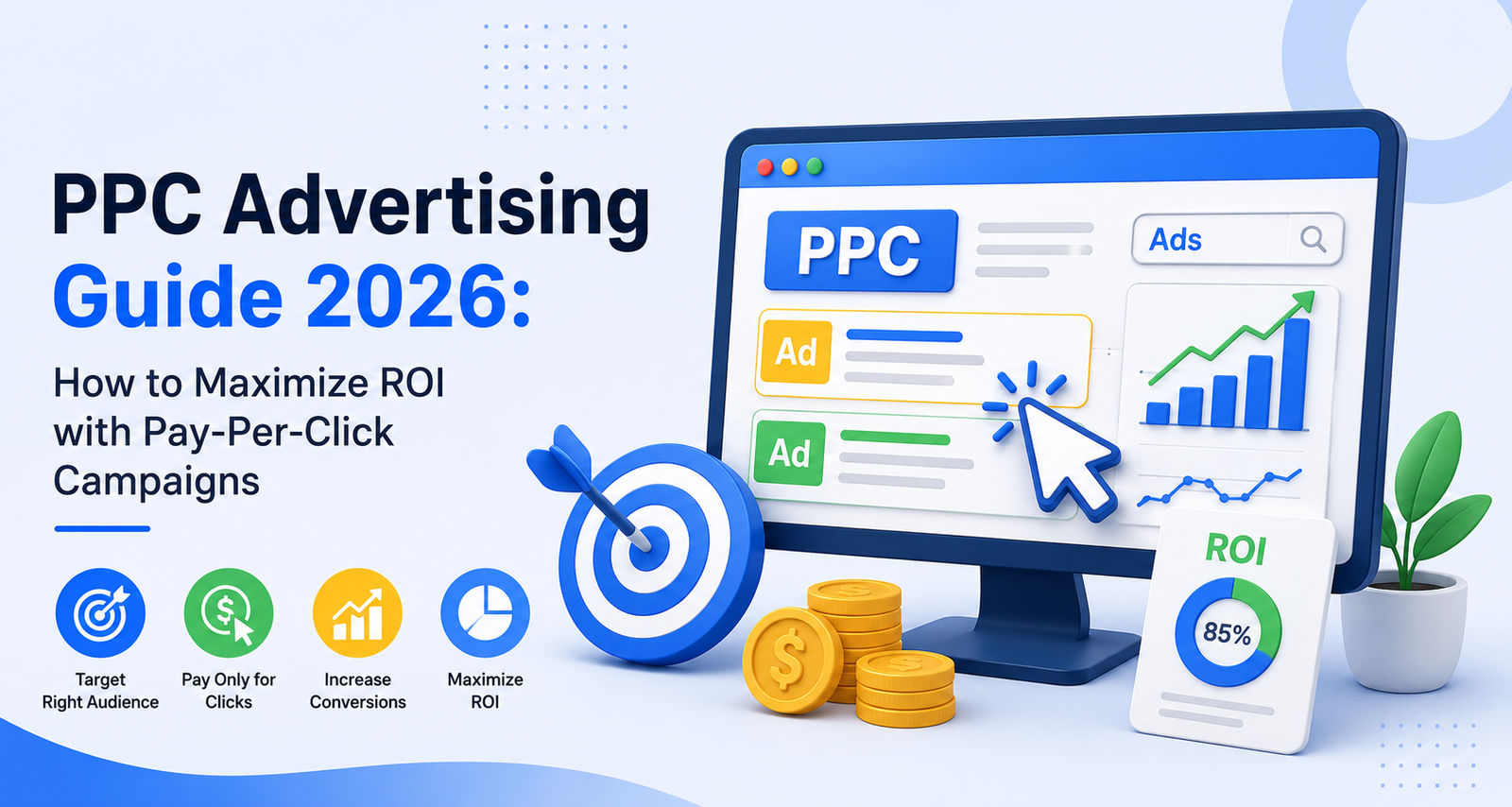
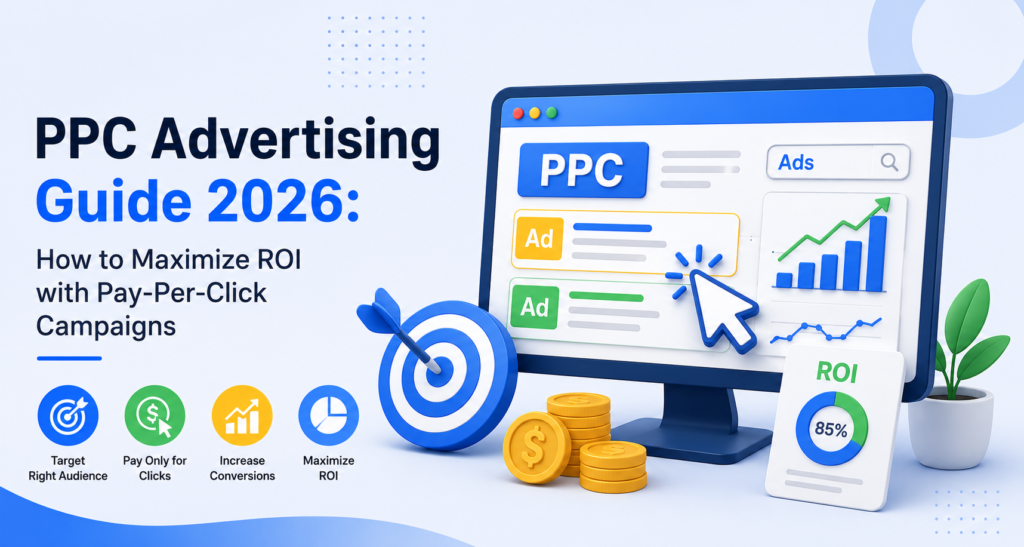
Pay-per-click (PPC) advertising is a model where advertisers pay a fee each time their ad is clicked, rather than earning visibility organically. The most common platforms include:
- Google Ads (Search, Display, Shopping, Performance Max)
- Microsoft Advertising (Bing Ads)
- Social media ads (Meta, LinkedIn, TikTok)
- Retargeting/remarketing networks
Unlike SEO, which builds momentum over months, PPC delivers immediate visibility — your ad can appear at the top of search results the same day a campaign launches. This makes it ideal for product launches, time-sensitive promotions, and businesses that need leads now while SEO builds in parallel.
Why PPC Advertising Still Delivers Strong ROI in 2026
Search advertising continues to be one of the highest-intent marketing channels available, because it targets people actively searching for a solution — not passively scrolling. A well-optimized PPC campaign lets you:
- Control exactly how much you spend with daily and monthly budget caps
- Target with precision — by keyword, location, device, time of day, demographics, and audience behavior
- Measure ROI directly — every dollar spent is trackable to a lead or sale
- Scale quickly — increase budget on winning campaigns without waiting for organic growth
Core Components of a High-Performing PPC Campaign
1. Keyword Research & Match Types Effective PPC starts with identifying commercial-intent keywords — terms searchers use when they’re ready to buy or inquire, not just browse. Using the right match types (exact, phrase, broad with smart bidding) controls how tightly your ads match search queries.
2. Ad Copy That Converts Your ad copy needs to immediately communicate value and include a clear call-to-action. Testing multiple headlines and descriptions (A/B testing) is essential — even small copy changes can shift click-through rates significantly.
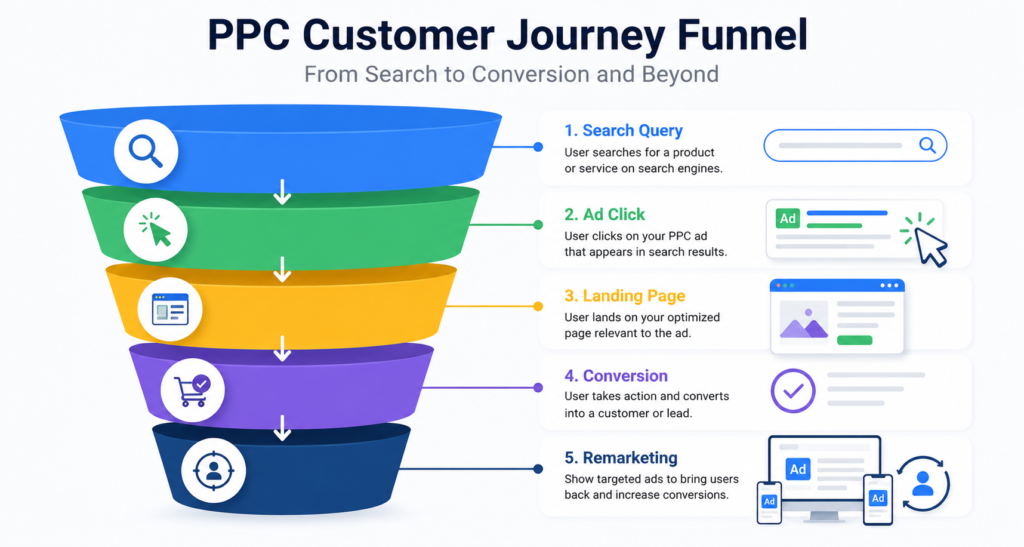
3. Landing Page Alignment This is where most campaigns fail. If your ad promises “Free Consultation” but the landing page is your generic homepage, conversions suffer. Landing pages should match ad intent exactly, load fast, and have a single, obvious conversion action.
4. Quality Score Optimization Google assigns a Quality Score based on expected CTR, ad relevance, and landing page experience. Higher Quality Scores lower your cost-per-click while improving ad position — meaning better SEO-aligned landing pages directly reduce PPC costs.
5. Negative Keywords Just as important as the keywords you target are the ones you exclude. Negative keyword lists prevent your budget from being wasted on irrelevant searches (e.g., excluding “free” or “jobs” for a paid service business).
Google Ads Campaign Types Explained
- Search Campaigns — text ads triggered by keyword searches; best for high-intent lead generation.
- Shopping Campaigns — product listings with images and prices, ideal for e-commerce.
- Display Campaigns — visual banner ads across the Google Display Network, useful for brand awareness and remarketing.
- Performance Max — Google’s AI-driven campaign type that spans Search, Display, YouTube, Gmail, and Maps from a single campaign, optimized automatically toward conversion goals.
- Remarketing Campaigns — targeting users who previously visited your site but didn’t convert, often delivering the highest ROI of any campaign type.
Budgeting for PPC: What to Expect
PPC costs vary widely by industry competitiveness. Legal, insurance, and home services tend to have higher cost-per-click due to high customer lifetime value, while niche B2B or local service industries often see more affordable CPCs.
A healthy PPC budget strategy typically allocates:
- 70-80% to proven, high-converting campaigns and keywords
- 10-20% to testing new keywords, ad formats, or audiences
- A dedicated remarketing budget, since it typically delivers the lowest cost-per-conversion
Rather than fixating on the lowest possible cost-per-click, focus on cost-per-acquisition (CPA) and return on ad spend (ROAS) — the metrics that actually reflect profitability.
Common PPC Mistakes That Waste Budget
- Sending all traffic to the homepage instead of dedicated landing pages
- Ignoring negative keywords, leading to irrelevant clicks
- Set-it-and-forget-it management — PPC requires weekly monitoring and optimization, not a one-time setup
- Broad match keywords without smart bidding strategy, causing budget waste on loosely related searches
- No conversion tracking, making it impossible to know which keywords or ads are actually profitable
PPC vs. SEO: Which Should You Prioritize?
The honest answer depends on your timeline and goals. PPC delivers immediate visibility and is ideal for:
- New businesses needing leads before organic rankings build
- Time-sensitive promotions or seasonal offers
- Testing which keywords and messaging convert best (data that can later inform SEO content strategy)
SEO, meanwhile, builds a compounding, lower-cost-per-lead asset over time. The strongest strategies use both — PPC for immediate results and market testing, SEO for sustainable long-term growth.
How to Choose a PPC Management Agency
Look for a partner that:
- Provides transparent reporting on spend, clicks, conversions, and cost-per-acquisition
- Uses certified platforms and tools like Google Analytics and Google Tag Manager for accurate conversion tracking
- Actively manages campaigns weekly, not just monthly check-ins
- Aligns PPC landing pages with conversion-focused design principles
- Has experience in your specific industry, since bidding strategy and audience targeting vary significantly by vertical
Measuring PPC Success: Key Metrics
- Click-Through Rate (CTR) — percentage of people who click your ad after seeing it
- Cost Per Click (CPC) — average amount paid per click
- Conversion Rate — percentage of clicks that result in a lead or sale
- Cost Per Acquisition (CPA) — total cost to acquire one customer
- Return on Ad Spend (ROAS) — revenue generated per dollar spent
Understanding PPC Bidding Strategies
Choosing the right bidding strategy significantly affects both cost and results. Common approaches include:
- Manual CPC bidding — full control over individual keyword bids, useful for accounts with strong historical data and specific budget priorities
- Maximize Conversions — Google’s automated bidding aims to get the most conversions within your budget, ideal once a campaign has enough conversion data to optimize against
- Target CPA (Cost Per Acquisition) — bids automatically adjust to hit a specific cost-per-conversion goal
- Target ROAS (Return on Ad Spend) — prioritizes conversion value over volume, best suited for e-commerce accounts with variable order values
- Enhanced CPC — a hybrid approach that adjusts manual bids up or down based on the likelihood of conversion
Automated bidding strategies generally perform best once a campaign has accumulated sufficient conversion history (typically 30+ conversions per month) for Google’s machine learning to optimize effectively.
The Role of Ad Extensions in PPC Performance
Ad extensions (now called “assets” in Google Ads) expand your ad with additional information and clickable options, often improving CTR without additional cost per impression:
- Sitelink extensions — additional links to specific pages (services, about, contact)
- Call extensions — a clickable phone number, critical for mobile users ready to call immediately
- Location extensions — displays your address and a map marker, reinforcing local relevance
- Callout extensions — short highlighted phrases (e.g., “Free Consultation,” “24/7 Support”)
- Structured snippet extensions — highlighting specific services, brands, or product categories
Ads with well-configured extensions consistently see improved ad rank and lower effective costs, since they contribute positively to Quality Score.
Frequently Asked Questions About PPC Advertising
How much should I budget for PPC advertising? Budget depends heavily on your industry’s average CPC and your conversion goals. A useful starting approach is calculating your target number of monthly leads, multiplying by your industry’s average cost-per-conversion, and treating that as your baseline monthly budget before scaling.
How quickly will I see results from PPC? Unlike SEO, PPC can generate clicks and leads within hours of launching a campaign. However, meaningful optimization and stable performance data typically take 4 to 6 weeks as the algorithm gathers conversion data.
What’s the difference between PPC and social media ads? PPC (search advertising) targets people actively searching for a solution, capturing high intent. Social media ads target people based on demographics and interests while they’re browsing, which is better suited for awareness and discovery rather than immediate high-intent conversion.
Do I need a separate landing page for every PPC campaign? Ideally, yes. Dedicated landing pages that match ad messaging exactly consistently outperform generic homepage traffic in both conversion rate and Quality Score.
PPC Done Right Is a Growth Multiplier
PPC advertising isn’t about spending the most money — it’s about spending strategically, testing constantly, and optimizing relentlessly toward profitable outcomes. Businesses that treat PPC as a data-driven discipline, rather than a “set it and hope” tactic, consistently see the strongest returns.
At SkyhawkBiz, our PPC specialists bring two decades of hands-on campaign management experience to build advertising strategies that generate real leads, not just clicks.
Ready to turn ad spend into measurable revenue? Get a free PPC account audit from SkyhawkBiz.