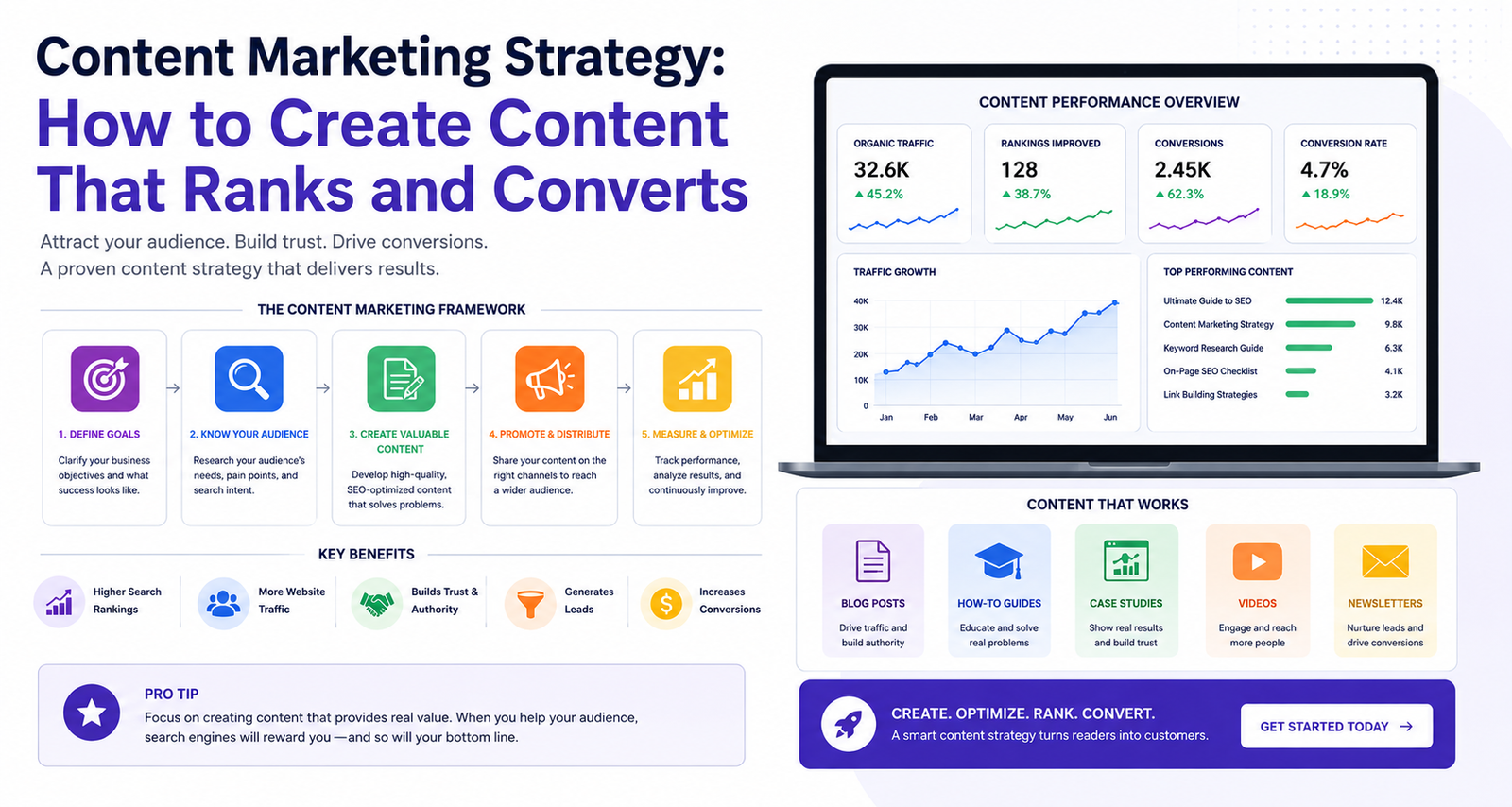
Publishing content for the sake of publishing content is one of the most common – and expensive – mistakes businesses make in digital marketing. Blogs that never rank, social posts with no strategy behind them, and “content calendars” filled with generic topics rarely move the needle. A real content marketing strategy, by contrast, builds organic traffic, establishes authority, and turns readers into customers.
With over 20 years of combined experience in content strategy and SEO, the SkyhawkBiz team has developed a framework that consistently produces content that both search engines and real people value. Here’s how to build a content marketing strategy that actually works in 2026.
What Is Content Marketing, Really?
Content marketing is the strategic creation and distribution of valuable, relevant content designed to attract, engage, and retain a clearly defined audience – ultimately driving profitable customer action. It spans multiple formats:
- Blog posts and articles
- Long-form guides and whitepapers
- Video content
- Infographics and visual content
- Case studies and customer stories
- Email newsletters
- Podcasts
Unlike direct advertising, content marketing works by earning attention and trust rather than interrupting it – which is why it consistently produces higher engagement and lower long-term cost per lead when done correctly.
Why Content Marketing and SEO Are Inseparable
Content is the fuel that makes SEO work. Without genuinely useful, well-optimized content, there’s nothing for search engines to rank or for backlinks to point toward. Google’s own guidelines emphasize E-E-A-T – Experience, Expertise, Authoritativeness, and Trustworthiness – as core to how content quality is evaluated, meaning thin or AI-generated-without-review content increasingly struggles to rank.
Effective content marketing in 2026 requires:
- Genuine expertise or experience reflected in the content (real insights, not generic rehashed information)
- Clear authorship and credibility signals
- Original data, examples, or perspectives wherever possible
- Content that fully satisfies search intent rather than skimming the surface of a topic
Step 1: Audience and Keyword Research
Before writing anything, understand exactly who you’re writing for and what they’re searching for. This involves:
- Identifying buyer personas – their pain points, questions, and stage in the buying journey
- Keyword research – using tools like SEMrush or Google Keyword Planner to find search terms with meaningful volume and achievable competition
- Search intent mapping – categorizing keywords by informational, navigational, commercial, or transactional intent, since content format and CTA should match intent
Step 2: Build a Content Pillar Strategy
Rather than publishing disconnected, random topics, organize content around pillar pages (broad, comprehensive guides on core topics) supported by cluster content (specific, related subtopics that link back to the pillar). This structure:
- Signals topical authority to search engines
- Improves internal linking and site architecture
- Makes it easier for users to navigate related content
- Concentrates ranking power around your most important commercial topics
Step 3: Create Content That Actually Delivers Value
The difference between content that ranks and converts versus content that sits unread often comes down to depth and specificity:
- Answer the actual question thoroughly – don’t pad content with fluff to hit a word count
- Use original examples, data, or case studies where possible
- Structure content for scannability – clear headers, bullet points, short paragraphs
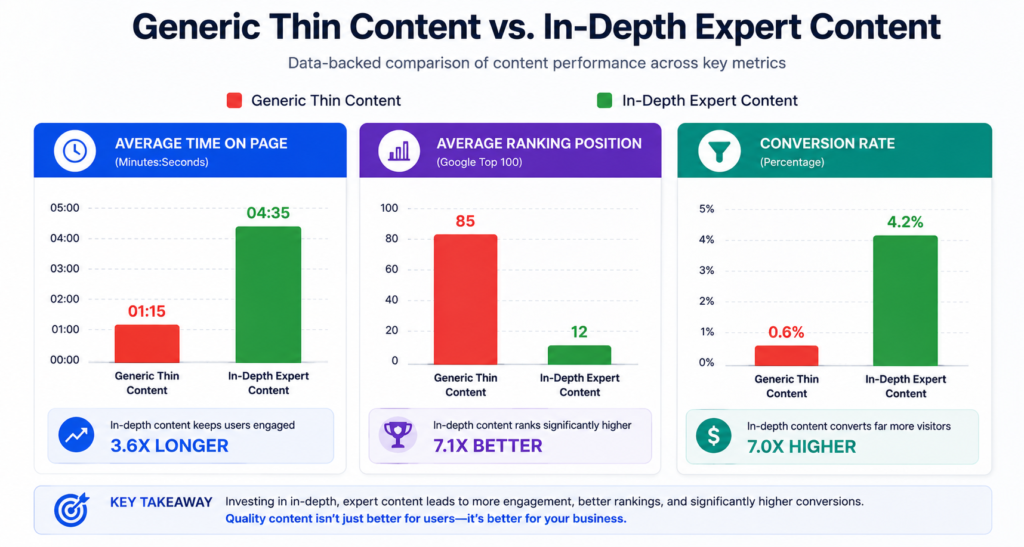
- Include visuals – infographics, screenshots, and images improve engagement and time-on-page
- Write for humans first, search engines second – Google’s algorithms are increasingly sophisticated at detecting content written purely for ranking rather than genuine usefulness
Step 4: Optimize for Search Without Sacrificing Quality
On-page optimization should feel invisible to readers while still signaling relevance to search engines:
- Natural keyword integration in titles, headers, and body content – never forced or repetitive
- Compelling title tags and meta descriptions that accurately reflect content and encourage clicks
- Internal links to related pillar and cluster content
- External links to authoritative sources when citing data or statistics
- Optimized images with descriptive alt text and compressed file sizes
Step 5: Promote and Distribute Content
Publishing content is only half the strategy – distribution determines whether it gets seen:
- Repurpose blog content into social media posts, email newsletters, and short-form video
- Share with existing email lists to drive initial traffic and engagement signals
- Outreach for backlinks to relevant industry sites, guest posting, and digital PR
- Update and refresh older content periodically rather than only publishing new pieces – content decay is real, and refreshed content often regains lost rankings faster than new content earns them
Step 6: Measure What Matters
Track content performance against real business outcomes, not just traffic volume:
- Organic traffic per page and keyword ranking movement
- Average time on page and scroll depth, indicating genuine engagement
- Conversion rate from content pages (newsletter sign-ups, form fills, downloads)
- Backlinks earned from published content
- Assisted conversions – content that influences a sale even if it wasn’t the final touchpoint
Common Content Marketing Mistakes
- Publishing without a strategy – random topics with no keyword or audience research behind them
- Keyword stuffing at the expense of readability
- Ignoring search intent, producing a listicle when the searcher wanted an in-depth guide (or vice versa)
- Never updating old content, letting once-ranking pages decay and lose relevance
- No clear conversion path, leaving engaged readers with nowhere to go next
- Treating content and SEO as separate departments rather than an integrated strategy
Content Marketing for Different Business Types
- B2B businesses benefit most from in-depth guides, whitepapers, case studies, and LinkedIn-distributed thought leadership content that supports longer sales cycles.
- E-commerce businesses benefit from buying guides, product comparison content, and SEO-optimized category descriptions that capture commercial-intent searches.
- Local service businesses benefit from location-specific content, FAQ-style pages addressing common customer questions, and case studies from local projects.
How to Choose a Content Marketing Partner
Look for an agency or team that:
- Conducts real keyword and competitive research before writing, not just topic guessing
- Employs writers with genuine subject matter understanding, not purely generic freelance output
- Builds content within a pillar/cluster strategy connected to overall SEO goals
- Provides performance reporting tied to traffic, rankings, and conversions – not just publishing volume
The Impact of AI on Content Marketing in 2026
AI tools have transformed how content gets researched, drafted, and produced, but they’ve also raised the bar for what qualifies as genuinely valuable content. Search engines have become increasingly capable of identifying generic, unedited AI output – meaning businesses that use AI purely to mass-produce shallow content are seeing diminishing returns. The businesses winning with content marketing in 2026 typically use AI as an efficiency tool within a human-guided strategy:
- AI for research and outlining, accelerating the early stages of content planning
- Human expertise for accuracy, nuance, and genuine insight, especially in specialized or regulated industries
- Human editing and fact-checking before publication, since AI-generated content still requires verification
- Original data, case studies, and firsthand experience that AI cannot fabricate credibly – this is precisely what Google’s E-E-A-T guidelines reward
Repurposing Content for Maximum ROI
One of the most underused content marketing tactics is systematically repurposing a single piece of cornerstone content into multiple formats, multiplying its reach without multiplying the research and strategy work behind it:
- A long-form guide becomes a series of social media posts highlighting key points
- Key statistics become a shareable infographic
- The core narrative becomes a short-form video script
- Sections become the basis for an email newsletter series
- Multiple related articles get compiled into a downloadable lead-generation guide
This approach maximizes the return on the time invested in original research and writing, while reinforcing consistent messaging across every channel your audience uses.
Frequently Asked Questions About Content Marketing
How often should a business publish new content? Consistency matters more than sheer frequency. Many successful content strategies publish 2-4 high-quality pieces per month rather than daily low-effort posts, prioritizing depth over volume.
How long does content marketing take to show ROI? Content marketing typically takes 4 to 6 months to show meaningful organic traffic gains, with compounding returns building over 12+ months as a content library and backlink profile grow.
Should every blog post target a specific keyword? Ideally yes, though not every piece needs to target a high-volume commercial keyword. Some content serves brand awareness, thought leadership, or top-of-funnel education, which still supports the overall content ecosystem even without directly driving conversions.
Is long-form content always better than short-form? Not universally – content length should match search intent. A quick factual query deserves a concise answer, while a comprehensive guide topic genuinely benefits from depth. Matching format to intent matters more than a fixed word count target.
Content Marketing Is a Compounding Asset
Unlike paid advertising, which stops generating results the moment spending stops, well-crafted content marketing continues to attract traffic, build authority, and generate leads for years after publication. The businesses that win with content marketing treat it as a long-term strategic investment – grounded in real audience research, genuine expertise, and consistent optimization – rather than a box to check off a marketing to-do list.
At SkyhawkBiz, our content strategists bring over two decades of combined experience crafting content that search engines rank and real customers act on.
Ready to build a content strategy that actually drives growth? Get a free content audit from SkyhawkBiz.