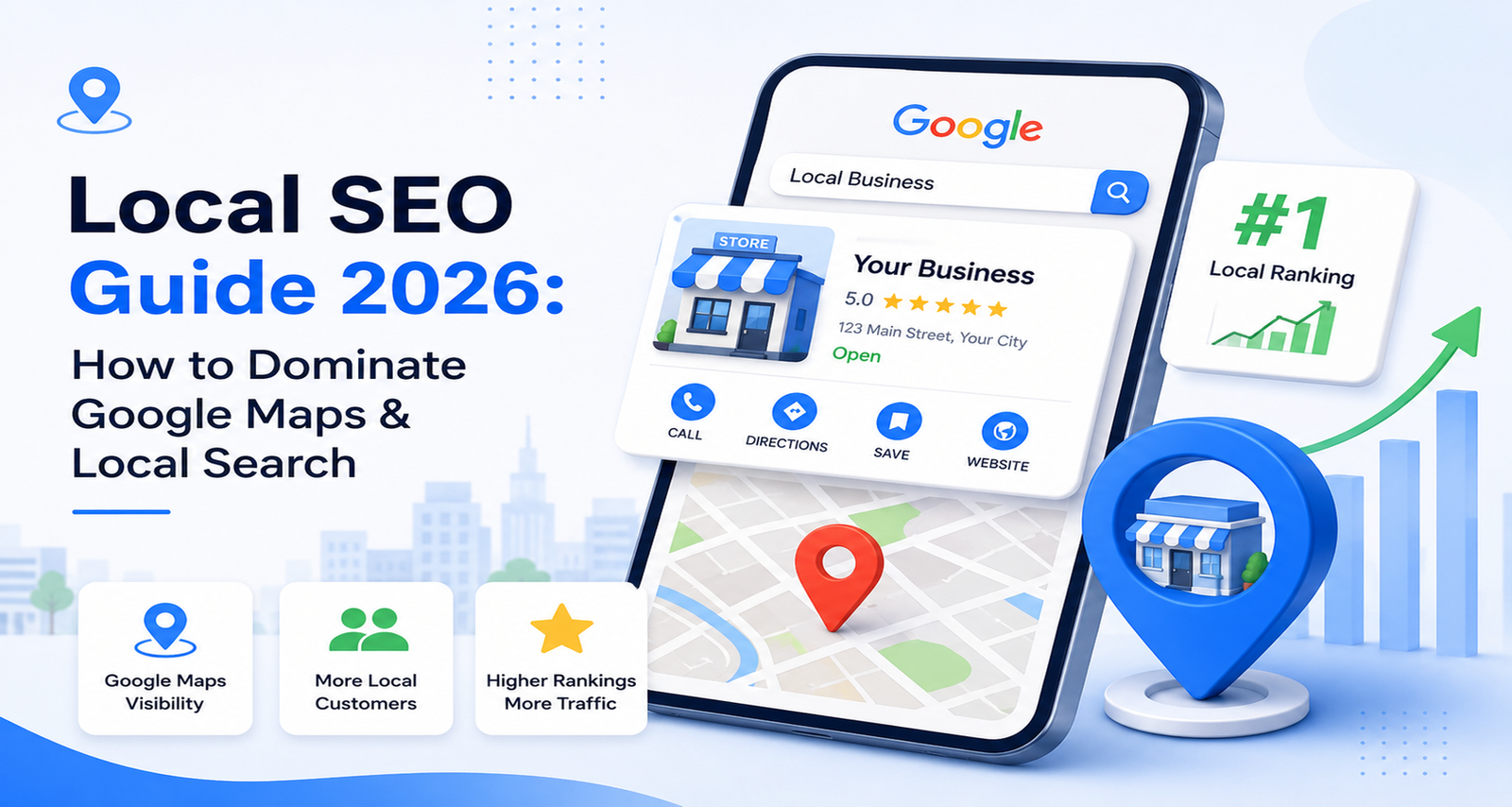
Nearly half of all Google searches have local intent – people searching for “near me,” a service in their city, or a specific neighborhood business. If your business isn’t showing up in the local map pack when nearby customers search, you’re losing revenue to competitors who are.
With over 20 years of combined digital marketing experience, the SkyhawkBiz team has helped local businesses – from single-location shops to multi-city service providers – climb to the top of local search results. This guide breaks down exactly how local SEO works and how to make it work for you in 2026.
What Is Local SEO?
Local SEO is the practice of optimizing your online presence to attract more business from relevant, geographically-related searches. Instead of competing nationally, you’re optimizing to be the top choice within your city, region, or service area – think “plumber in Dallas” or “coffee shop near downtown Chicago.”
Local SEO centers around three primary ranking pillars that Google itself has confirmed matter most:
- Relevance – how well your business profile and content match what the searcher is looking for.
- Distance – how close your business (or service area) is to the searcher’s location.
- Prominence – how well-known and trusted your business is, based on reviews, citations, and backlinks.
Google Business Profile: The Foundation of Local SEO
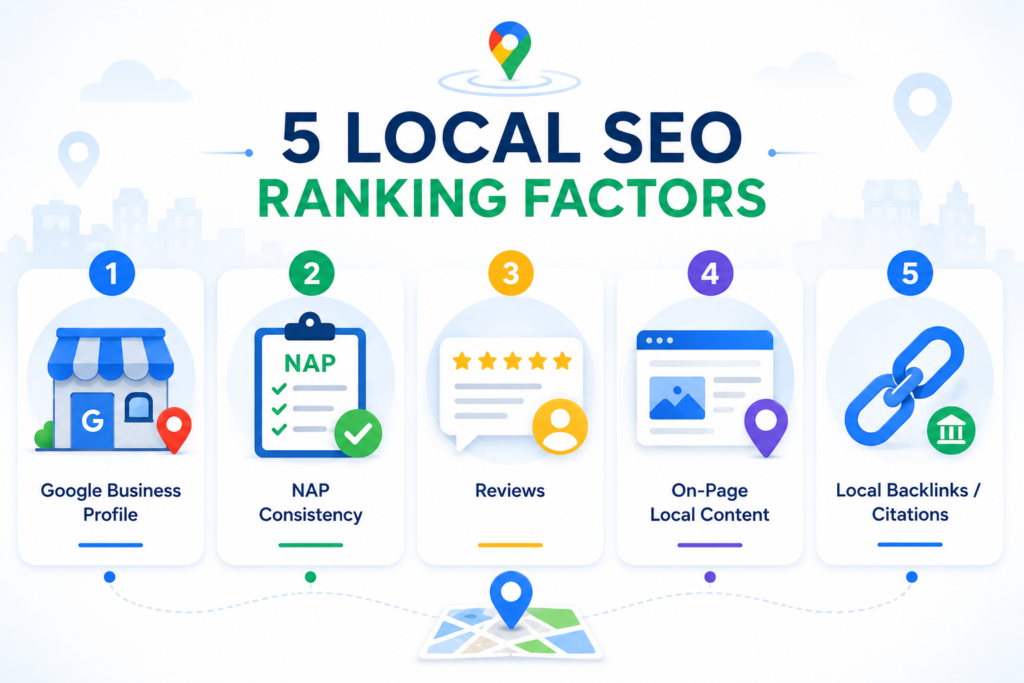
Your Google Business Profile (GBP), formerly Google My Business, is the single most important asset in local SEO. It’s what populates the map pack, the knowledge panel, and local pack results.
To optimize your GBP:
- Claim and verify your listing if you haven’t already.
- Choose accurate primary and secondary categories – this is one of the strongest local ranking signals.
- Complete every field – hours, services, attributes, business description, and service area.
- Add photos regularly – businesses with more photos receive significantly more requests for directions and website clicks.
- Post updates – using the GBP posts feature to share offers, news, and events keeps your profile active in Google’s eyes.
- Respond to every review, positive or negative, professionally and promptly.
NAP Consistency: The Overlooked Ranking Factor
NAP stands for Name, Address, Phone number. Google cross-references your NAP information across the web – your website, GBP, Yelp, Facebook, industry directories – to validate legitimacy. Inconsistent information (a wrong suite number, an old phone number on one directory) creates trust issues that can quietly suppress your rankings.
Action step: Conduct a citation audit across major directories (Yelp, Bing Places, Apple Maps, industry-specific directories) at least twice a year to catch and correct inconsistencies.
Online Reviews: Your Local Reputation Engine
Review quantity, quality, recency, and your response rate are all confirmed ranking factors for local search. Beyond rankings, reviews directly influence whether a searcher clicks your listing over a competitor’s.
Best practices:
- Ask satisfied customers for reviews immediately after a positive interaction (via text, email, or a QR code at checkout).
- Never buy fake reviews – Google actively detects and penalizes this, and it can result in profile suspension.
- Respond to negative reviews calmly and professionally; how you handle criticism is public and influences potential customers.
On-Page Local SEO: Optimizing Your Website
Your website should reinforce your local relevance:
- Location pages – if you serve multiple cities or regions, create a dedicated, unique page for each (avoid duplicate content across location pages).
- Local keywords in titles and headers – naturally include your city/region in title tags, H1s, and body content.
- Embedded Google Map on your contact page.
- Local schema markup (LocalBusiness structured data) to help Google understand your address, hours, and service area programmatically.
- Locally relevant content – blog posts about community events, local case studies, or region-specific guides build topical and geographic relevance.
Local Link Building & Citations
Backlinks from locally relevant, authoritative sources carry significant weight:
- Local chambers of commerce and business associations
- Local news outlets covering community events you sponsor or participate in
- Industry-specific local directories
- Partnerships with complementary local businesses (cross-promotion and linking)
Local SEO Packages: What’s Typically Included
Most local SEO packages are structured around business size and competitiveness of the local market:
- Single-location packages – GBP optimization, citation building, review management, and basic on-page local SEO.
- Multi-location packages – individual location page creation, centralized GBP management across locations, and localized content strategy per market.
- Service-area business packages – for businesses without a storefront (contractors, home services) that serve a defined radius rather than walk-in customers.
Common Local SEO Mistakes to Avoid
- Keyword stuffing your business name on GBP (e.g., “ABC Plumbing – Best Plumber Dallas”) – this violates Google’s guidelines and can get your listing suspended.
- Ignoring mobile experience – most local searches happen on mobile devices, often with immediate call or visit intent.
- Neglecting Google Posts and Q&A sections on your GBP, which Google increasingly surfaces in results.
- Duplicate or thin location pages that provide no unique value beyond a city name swap.
Measuring Local SEO Success
Track these metrics monthly:
- Map pack rankings for target keywords in your service areas
- GBP insights – views, calls, direction requests, and website clicks
- Review volume and average rating trends
- Local organic traffic via Google Analytics, segmented by landing page
Voice Search and Local SEO
With smart speakers and voice assistants now a routine part of daily life, voice search has become a meaningful contributor to local search traffic. Voice queries tend to be longer and more conversational than typed searches – “Where’s the closest bakery that’s open right now?” instead of “bakery near me.” Optimizing for voice search involves:
- Writing content in a natural, conversational tone that matches how people actually speak
- Creating dedicated FAQ sections that directly answer common questions in full sentences
- Keeping Google Business Profile hours, address, and phone number perfectly accurate, since voice assistants often read this information directly to the user
- Targeting long-tail, question-based keywords rather than short, generic phrases
Multi-Location Local SEO Challenges
Businesses operating in multiple cities face unique complexities that single-location businesses don’t. Common challenges include:
- Cannibalization – multiple location pages competing against each other for the same keywords if not properly differentiated
- Duplicate content risk – location pages that only swap a city name without unique local content
- Review management at scale – monitoring and responding to reviews across dozens of individual Google Business Profiles
- Centralized reporting – needing a unified view of performance across every location while still tracking location-specific metrics
The solution is a hub-and-spoke content model, where each location page includes genuinely unique details – local team members, location-specific service offerings, neighborhood references, and local customer testimonials – rather than templated content with a city name find-and-replace.
Frequently Asked Questions About Local SEO
How long does local SEO take to show results? Local SEO often moves faster than broader national SEO campaigns, with many businesses seeing map pack improvements within 2 to 3 months, since local ranking factors like Google Business Profile optimization can be addressed quickly.
Does my business need a physical storefront to rank locally? No. Service-area businesses without a public-facing storefront can still rank in local search by setting a defined service area within Google Business Profile and hiding their physical address, following Google’s specific guidelines for service-area businesses.
How many reviews do I need to rank well locally? There’s no fixed number, but review volume relative to competitors in your specific market matters. Consistent, ongoing review generation matters more than a one-time push to a high number.
Can I manage local SEO myself, or do I need an agency? Solo business owners can manage basic Google Business Profile optimization themselves. However, citation building, review generation systems, and multi-location strategy typically benefit from dedicated expertise, especially in competitive local markets.
Local SEO Is Where Customers Make Decisions
Local search is often the final step before a purchase decision — someone has already decided they need a service and
is choosing who to call. Winning that moment requires consistent, technically sound local SEO, not a one-time GBP
setup and forget-it approach.
At SkyhawkBiz, our local SEO specialists combine two decades of hands-on experience with proven local optimization
frameworks to help businesses become the obvious choice in their community. Whether you operate one storefront or
serve dozens of cities, a strong local SEO foundation turns nearby searches into paying customers.
Want to see how your business ranks locally right now? Request a free local SEO audit from SkyhawkBiz.